
The Flahute: Portrait of Cycling’s Last Romantics
There exists in cycling a word that defies translation, that carries within it the weight of cobblestones and rain, of working-class dignity and suffering transformed into art. Flahute. Say it aloud and you can almost hear the rattle of wheels over pavé, feel the cold northern rain seeping through wool jerseys, sense the grim satisfaction of riders who measure their worth not in glory but in endurance.
To understand the Flahute is to understand that cycling, at its purest, is not about the sun-drenched climbs of the Alps or the champagne sprint into Paris. It is about something older, something harder, something that speaks to the very essence of what it means to suffer on a bicycle.
Origins in Cloth and Mud
The word itself emerged from the rubble of post-war Europe, coined by French journalists who watched their Belgian neighbors with a mixture of admiration and incomprehension.1,2 These Flemish riders trained through snow and sleet, racing in conditions that would send sensible men indoors. The French needed a word for this particular brand of madness, and so Flahute entered the lexicon.
But the term’s roots reach deeper, into the soil of working-class Flanders. Originally, a Flahute was nothing more than a cloth bag—a long sack with shoulder straps that laborers used to carry their lunch: baguettes and cold coffee bouncing against their backs as they tramped across Flanders and Northern France on decrepit bicycles, searching for the next day’s work.5 This image—of men moving through the landscape on bikes, carrying everything they owned, always searching—became the foundation upon which cycling’s most romantic archetype was built.
The Definition of Hard
The Flahute regards the Tour de France as merely a series of extended training rides. A genuine race, in their eyes, unfolds in torrential rain and bitter cold on treacherous roads, where the prize money rivals a child’s weekly allowance.1
This is not posturing. It reflects a fundamental philosophical divide about what constitutes a true test of cycling. Roger De Vlaeminck, four-time winner of Paris-Roubaix and himself a noted Flahute, distilled it to its essence: they are simply those riders capable of traveling faster than anyone else across cobblestones in the rain.2
But even this undersells it. These were men who had watched their country torn apart by war, who faced a simple choice: spend their lives harvesting beets or become cyclists—either path guaranteed suffering, though one might also bring praise and perhaps glory.2
The Proving Grounds
The cobbled classics of March and April provide the canvas on which Flahutes paint their masterpieces. The Tour of Flanders, Paris-Roubaix—these are not races so much as trials by ordeal.7 Paris-Roubaix, that Queen of the Classics, that Hell of the North, features approximately thirty miles of pavé that breaks bikes and bodies with democratic cruelty.6 Since 1977, the victor receives a cobblestone as his trophy6—a fitting reward for those who have conquered what others merely survive.
The brutality is the point. When organizers added the notorious Wallers-Arenberg section through an abandoned mine, a concerned official asked what would happen if no one reached the finish. The race director’s reply carried the cold poetry of the true believer: “So long as there is one rider.”8
Briek Schotte: The Archetype
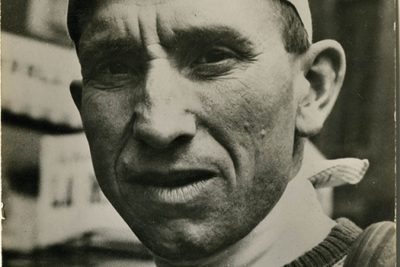
In the photograph, we see him: Briek Schotte, known as Iron Briek, one of the most successful Flandriens of the 1940s and ’50s. His face tells the story better than words ever could.
Born in 1919, Schotte saved for four years to buy a secondhand racing bike. When his father saw it, he threw it into the yard, declaring that cyclists were “the scum of the streets.”10,11 The young Briek retrieved his bike and trained for hours in the darkness after completing his farm work in West Flanders. This is the origin story of the Flahute: obstinacy in the face of dismissal, training in the dark, choosing the hard path because it was the only path that made sense.
He became world champion in 1948 and 1950, won stages of the Tour de France, finished second overall in 1948.9 But statistics cannot capture what made Schotte the quintessential Flahute. It was his relationship with the Tour of Flanders—twenty consecutive participations, eight podiums, two victories9—that defined him. It was his philosophy of suffering: “When I was suffering, then I was happy, because if I was suffering, then everyone else was dead.”12
Here we find the true Flahute mentality. Not mere toughness, but suffering as competitive advantage, pain as pleasure, misery as the purest form of racing.
When Schotte’s hometown proposed a statue in his honor, he agreed on two conditions: it must be no larger than life-size, and they must not place it on a pedestal.12 Even in bronze, he would remain at ground level with the people he came from.
He died on April 4, 2004—the day of the Tour of Flanders. Commentators covering the race suggested that God must have numbered among Briek’s greatest admirers.10,11 Eddy Merckx, himself a Flahute beneath all his Tour victories, called Schotte “the reference point for all of us, the father of the sport in this country.”13
The Physical Truth
What does it actually mean to ride cobblestones? Greg LeMond explained: Riding a cobbled section resembles climbing a steep, brief hill—the faster you travel, the smoother it becomes.15 But the technical demands are immense: reading the stones, selecting lines, anticipating gaps, avoiding fallen riders.15
Modern riders employ specialized frames, wheels, and tires. Punctures and mechanical failures remain common, often determining outcomes.6 The Flahutes of the past had no such luxuries. André Mahé, the 1948 winner, recalled: They raced the same machines used throughout the season, with no need for modifications because their bikes were far less rigid than modern equipment.6
Modern Inheritors
The tradition continues. Sean Kelly became the first and only Irish Flahute. Tom Boonen and Fabian Cancellara represent the most recent full embodiments of the type, with Greg Van Avermaet and Philippe Gilbert making compelling cases.1 In 2012, Boonen achieved what no other rider has: winning all four cobbled classics in a single season.7
Wout van Aert and Mathieu van der Poel, products of cyclocross—that discipline where riders train through conditions that recall those French journalists’ original observations about Belgians in the snow14—possess the potential to join this lineage.1
Who Fails the Test
If rain dampens your cycling spirit, you are definitively not a Flahute.1
Jacques Anquetil possessed the wisdom never to attempt qualification. Bernard Hinault numbered among the rare Frenchmen who might have succeeded.1 Some cyclists openly dismiss Paris-Roubaix for its harsh conditions6—and in doing so, disqualify themselves entirely from consideration.
The pointed observation that Lance Armstrong lacked the requisite anatomy for Flahute status1 speaks not merely to physical courage but to something deeper: a willingness to embrace suffering as an end in itself, to find meaning in misery, to return year after year to races that offer little reward beyond the satisfaction of having survived them.
The Last Romantics
In our current era of marginal gains and wind tunnels, of sports scientists and performance nutritionists, of carbon fiber and million-euro contracts, the Flahute represents something endangered: cycling as labor, suffering as virtue, the cobblestones of Northern Europe as the truest measure of what it means to race a bicycle.
The Flahute embodies a complete philosophy that privileges terrible conditions and working-class grit over glamour and comfort. It is not sufficient merely to be tough—many riders possess toughness. It is not sufficient to win occasionally on pavé—many have claimed Paris-Roubaix or the Tour of Flanders through tactics or fortune.
The true Flahute returns to these races year after year, thriving where others withdraw, discovering joy in suffering that breaks ordinary humans, maintaining humble, working-class dignity even in victory. They view the Tour de France—cycling’s greatest prize—as nothing more than long training rides because real racing occurs in cold rain on treacherous roads where prize money barely covers expenses.
Briek Schotte remains the perfect exemplar: the farmer’s son training in darkness after work, suffering gladly because he knew others suffered more, riding his beloved Flanders twenty consecutive times, requesting his statue stand at ground level. When death came for him on the day of that race, it seemed entirely appropriate—a fitting conclusion to a life that perfectly embodied what it means to be a Flahute.
The word still defies translation. Perhaps it must. Some things exist beyond language, in the realm of rain and mud and cobblestones, where suffering becomes transcendent and the hardest of the hard find something like grace.
Sources:
- “What is a Flahute?” – Flahute.com
- “Flahute: The Hardest of the Hardmen” – Velominati
- “How to Get Your Friends and Family to Talk About Cycling” – Bicycling
- “Tour de France Vocabulary 101” – Active
- “The First Lion of Flanders” – Cycling Legends
- “Paris–Roubaix” – Wikipedia
- “Cobbled classics” – Wikipedia
- “Roubaix and the hunt for cobbles” – The Inner Ring
- “Briek Schotte” – Wikipedia
- “Briek Schotte” – Cycling Legends
- “Iron Briek” – Cycling Legends
- “From Boonen’s legs to Iron Briek: A brief tour of Belgium’s best cycling statues” – Road.cc
- “Briek Schotte” – Flandria Bikes
- “How to Talk Like a Cyclist” – Bicycling
- “When the Tour de France meets the Paris-Roubaix cobbles” – Cyclingnews